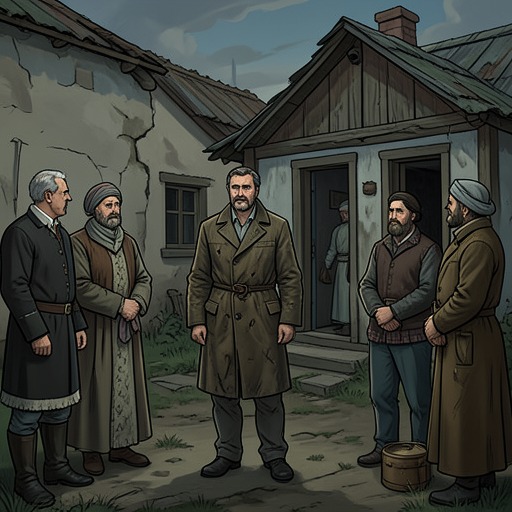
Sergeyich seeks Akhtem and is invited to place his hives
Grey BeesSergeyich seeks Akhtem and is invited to place his hives at the family apiary in Crimea. The meeting gives the displaced beekeeper a possible refuge, but it also confronts him with the consequences of a disappearance: Akhtem has been gone for twenty months, his family has received no reliable account of his fate, and Sergeyich’s search becomes part of the effort to establish what happened to his friend.
The Search and the News
Sergeyich arrives at Akhtem’s home expecting to find his fellow beekeeper. A woman in a black sweater and long skirt, with a purple scarf around her head, answers the door. When he asks about Akhtem, she first tries to understand who the visitor is and where he comes from. Sergeyich explains that he is from Donbas and that his house is in the grey zone; he and Akhtem had met at a beekeepers’ convention in Sloviansk and shared a room at a boarding house. He has brought his own hives and hopes to find somewhere nearby where his bees can fly in peace.
The woman, Aisylu, tells her daughter in Crimean Tatar that a friend of her father’s has come from Donbas, then switches to Russian to explain that Akhtem is gone: he was taken twenty months earlier. The news stops Sergeyich. The immediate purpose of his visit has been to find Akhtem and discuss a place for the bees; instead, he learns that his friend’s absence is part of a much longer and unresolved crisis for the household.
Aisylu says that Akhtem’s bees are kept in an apiary behind the vineyards, near the mountain, and that their children, Aisha and Bekir, look after them, mostly Bekir. She offers Sergeyich a place for his own hives beside theirs. Her welcome is practical as well as sympathetic: she proposes to show him the way and ride with him because the apiary is not far away.
A Possible Refuge Among the Hives
The invitation answers the immediate need that brought Sergeyich to the house. He wants to release his bees as soon as possible and settle them somewhere they can forage without the danger and disruption of the grey zone. Aisylu’s offer makes the family apiary available as a neighboring place for his hives, and she offers lunch as well. He declines the meal, focused on getting the bees out, but accepts her help in finding the apiary.
On the way, Aisylu asks what happened to his car. Sergeyich reluctantly explains that a drunk, shell-shocked by the war, attacked it after a wake for a friend who had been killed. This disclosure places his own displacement and damaged property alongside the family’s loss: both arrive at the encounter through violence, though their immediate circumstances differ. The shared apiary offers a form of ordinary cooperation—not an answer to the war, but a practical arrangement through which Sergeyich and Akhtem’s family can live near one another and care for their bees.
The Disappearance and Its Uncertainty
Aisylu later tells Sergeyich that the Cossacks took Akhtem. Three people were taken that day, she says; they had driven together to the mosque in Bakhchysarai. The car was left empty, and a little boy saw them being forced into a minibus. The family has heard nothing since. Aisylu says she does not know whether Akhtem was sent to Russia. Her account supplies a last known journey and a witness to the seizure, but not a confirmed destination or explanation.
Sergeyich blurts out that they cannot do this, then recognizes the helplessness of the protest. The news brings back his memory of a murdered young man amid shelling, linking the new account of Akhtem’s disappearance to the violence he has already encountered in the Donbas. Aisylu does not offer a resolution; she tells him to come to her if he needs anything. Her invitation establishes a relationship of mutual support while leaving the central question of Akhtem’s fate open.
That uncertainty becomes sharper when Sergeyich later asks Ivan Fyodorovich about Akhtem. Told to have Akhtem’s widow speak to the police, he fixes on the word “widow” and asks whether Aisylu is one. Ivan Fyodorovich retracts the wording, saying he misspoke and that the case remains open. He adds that the police have at least two dozen such cases, but that they are beyond his office’s control. The exchange gives Sergeyich neither confirmation of death nor a route to certainty: the official response identifies a wider pattern of unresolved cases while retreating from the implication that Akhtem is dead.
From Missing to Found
The uncertainty ends only when a Tatar man tells Sergeyich that Akhtem has been found buried in the woods and had been killed long ago. The discovery confirms the death that the official’s careless reference to a widow had suggested but not established. Sergeyich looks toward Aisylu’s house, where lights are on in every window, and asks why so many police are there. The scene places the news of Akhtem’s recovery amid the presence of authorities and the still-lit family home; finding his remains does not erase the unanswered questions surrounding his disappearance.
When Sergeyich later offers his condolences, Aisylu thanks him for going to Simferopol. She says that without his visit, Akhtem would not have been returned. The outcome gives his search a consequence beyond his own need for a place to keep bees: his persistence has helped the family recover Akhtem. Sergeyich then tells her that an official had called her a widow, information he had withheld earlier. The conversation joins the earlier uncertainty to the eventual confirmation, while allowing Aisylu to acknowledge his role in bringing her husband back.
Significance of the Encounter
The meeting begins with a beekeeper seeking another beekeeper and a place for his hives. It becomes an encounter with the human cost of enforced disappearance, in which a family’s account, an official’s ambiguous language, and the eventual discovery of Akhtem’s remains arrive at different times. The delay matters: for twenty months, the family lives without a reliable answer, while Sergeyich’s question about whether Aisylu is a widow shows how a single word can make the feared outcome feel present without proving it.
The apiary gives the relationship a concrete form. Aisylu’s offer is rooted in shared work and in the bees that Akhtem’s children continue to tend; Sergeyich can place his hives beside theirs rather than remain a stranger passing through. His later journey to Simferopol connects that welcome to action on behalf of the family. The episode thus ties the practical movement of bees and their keeper to a search for a missing person, making hospitality, investigation, and the eventual return of Akhtem’s remains parts of the same developing bond.